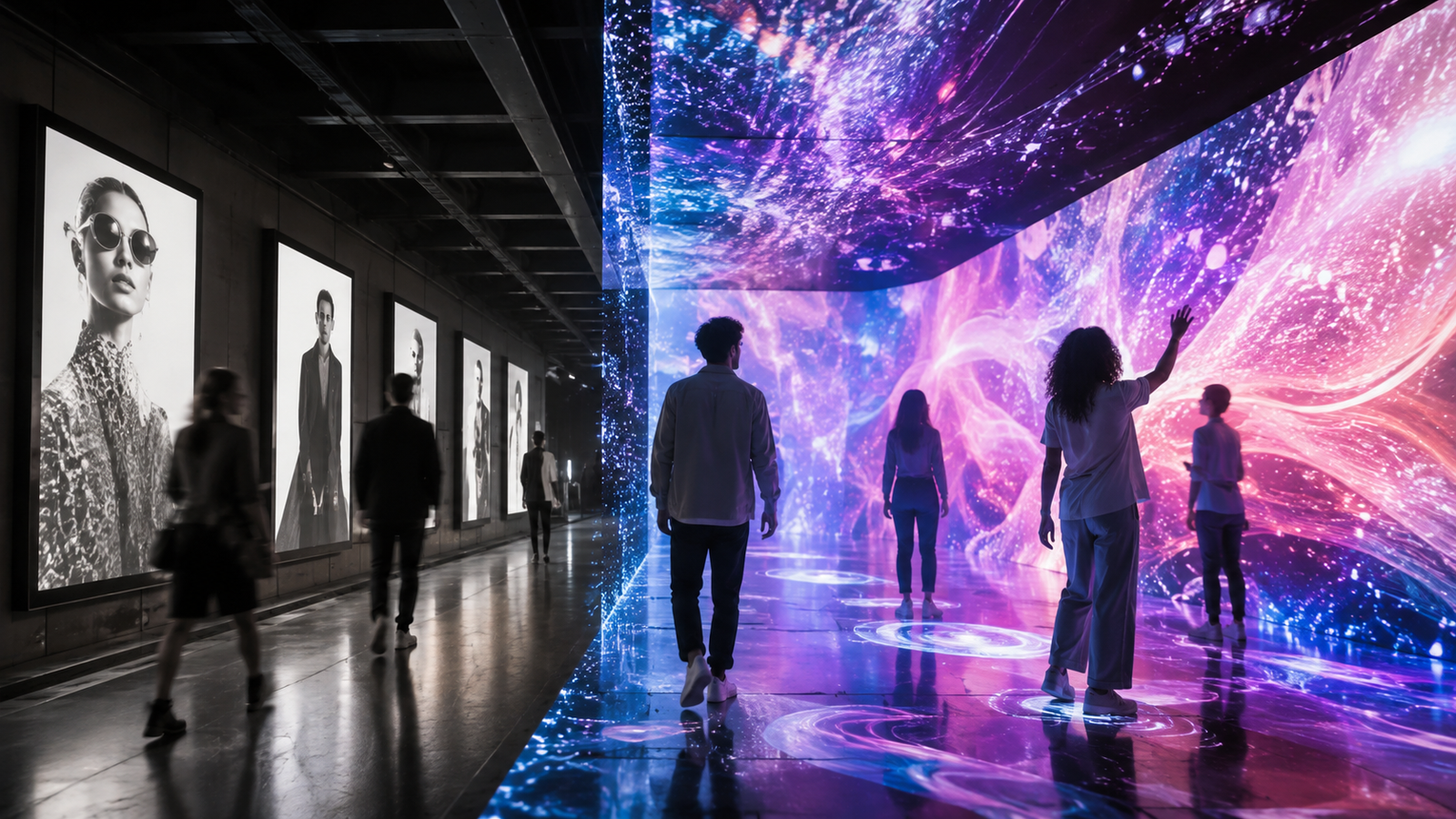
People Don't Want to Just See Your Brand Anymore
People Don't Want to Just See Your Brand Anymore
Blog
Blog
Based in London, UK
(©2021 — 2026)
Scroll Down
People Don't Want to Just See Your Brand Anymore
By the CEO, Metatron Ads
For a long time, advertising was built around one basic idea:
- Get the customer's attention.
- Put the brand in front of them.
- Make the message memorable.
- Get them to respond.
But something interesting is happening.
People are increasingly tired of simply being shown things.
And that is where immersive media becomes interesting.
From Watching to Participating
Imagine launching a new product.
You can make a film about it.
Or you can create an environment where people can actually experience what the product does.
You can show someone a destination.
Or you can allow them to explore it virtually.
You can explain a complex technology through a brochure.
Or you can create an interactive experience that allows someone to understand it in a few minutes.
The difference is participation.
And participation creates a different kind of memory.
Immersive Doesn't Have to Mean Complicated
When people hear “immersive media,” they sometimes immediately think of VR headsets, giant LED walls and expensive installations.
Those can certainly be part of it.
But immersive experiences can be much simpler.
- An interactive product experience.
- A projection-mapped installation.
- An augmented reality experience.
- A 360-degree environment.
- A digital walkthrough.
- An interactive exhibition.
- A phygital experience connecting an offline interaction to a digital journey.
Start With the Question, Not the Technology
This is where I think brands sometimes go wrong.
Someone says:
“We should do VR.”
Why?
“Because VR is exciting.”
That's not enough.
The first question should be:
If the answer is compelling, then we decide what technology can deliver it.
Not the other way around.
Immersive Media Can Make Complicated Things Simple
This is particularly powerful for industries where the product isn't immediately understandable.
- Technology
- Healthcare
- Pharma
- Engineering
- Infrastructure
- Manufacturing
- Financial services
A conventional presentation may require 30 slides to explain something.
A well-designed interactive experience might allow someone to understand it intuitively.
Experiences Are Becoming Part of Brand Building
The old marketing funnel was relatively straightforward:
Today, there is another layer becoming increasingly important:
People photograph experiences.
They share them.
They talk about them.
They take other people to them.
The brand becomes part of something they actually did.
That is fundamentally different from simply seeing an advertisement.
Recent industry research in India reflects this broader shift toward participation-led brand engagement, with experiential marketing increasingly being treated as a strategic brand-building activity rather than a one-off activation.
The Opportunity for Brands
I don't think immersive media will replace advertising.
It shouldn't.
- Advertising creates reach.
- Content creates familiarity.
- Performance marketing creates action.
- Immersive experiences create memory and involvement.
The opportunity is to connect all of them.
Imagine someone sees your campaign online.
They interact with your content.
They visit your immersive experience.
They share it.
They later search for your brand.
And eventually become a customer.
That's the Future I Find Exciting
Technology will continue to change.
Today it might be AR.
Tomorrow it may be spatial computing, AI-generated environments or something we haven't even named yet.
But the underlying principle won't change.
So perhaps the question brands should be asking isn't:
“How do we get people to see us?”
It should be:
“What can we make people experience that they will want to remember?”
That's where immersive media becomes much more than a technology.